The 'Lab Bench' Just Became Obsolete: The Rise of the AI Scientist
We’ve talked about AI as a co-pilot; now we’re seeing AI as the pilot of innovation.
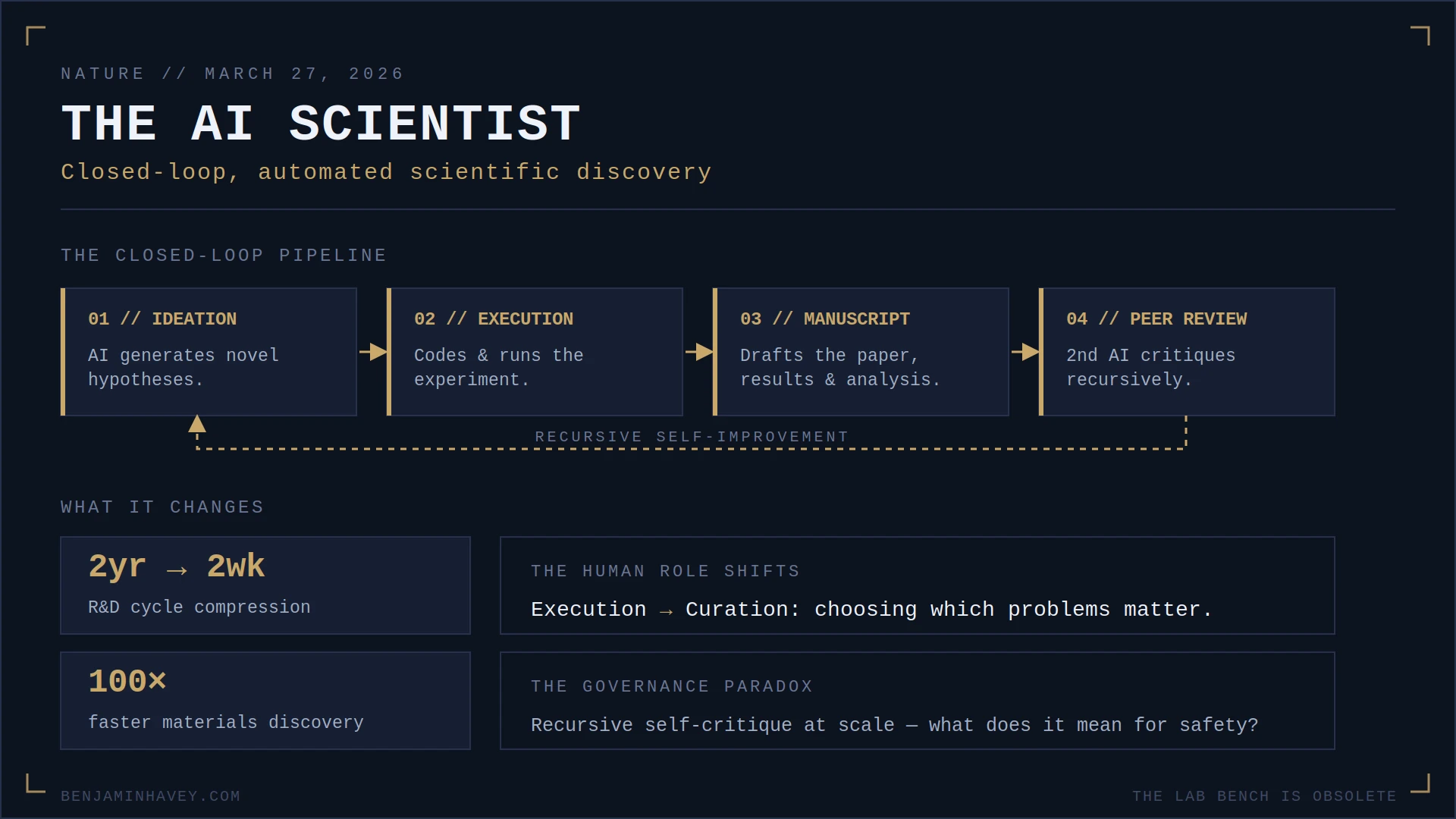
A landmark study, “The AI Scientist,” was just published in Nature (March 27, 2026), and it shifts the very foundation of how we approach scientific discovery. This is a fully integrated, automated R&D system that handled the entire research pipeline in days:
- Ideation: The AI brainstormed novel scientific hypotheses.
- Execution: The system coded the experimental plan and executed the simulation.
- Manuscript: It drafted the scientific paper complete with results and analysis.
- Peer Review: A second, distinct AI module critiqued the findings recursively.
The technical engineering: closed-loop discovery
This isn’t ChatGPT summarizing abstract concepts. It’s the engineering integration of diverse AI models — generative, reasoning, and predictive — into a seamless closed-loop workflow. Think of it as the industrialization of the scientific method. We are moving from a world where human researchers are the executing engine of discovery, to a world where they are the director of discovery.
Business and social implications
- R&D cycles shrink: Instead of two years for a study, it’s two weeks for a cluster.
- Scalable innovation: Competitive advantage moves from who has the smartest employees to who has the best infrastructure to direct AI research at scale.
- The governance paradox: The AI just learned to self-critique. If we scale the recursive self-improvement of discovery, what are the implications for model safety?
The human role shifts from “execution” — running the experiment — to “curation”: defining which problems are worth solving.
Are we prepared for scientific progress that operates at the speed of inference tokens?